

The Dangers of AI Policing

By: Michaeljon Murphy
Director of Communications
Constitution Party of Wisconsin
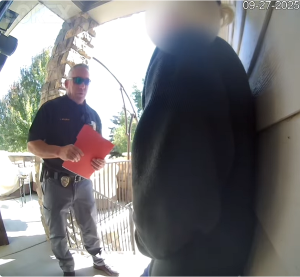
Sergeant Jamie Milliman
Youtube screenshot
In September 2025, Denver, Colorado resident Chrisanna Elser was accused of stealing a package from a porch in the nearby suburb of Bow Mar. Sergent Jamie Milliman of the Columbine Valley Police Department came to her door armed with his holstered service firearm, video evidence, pictures of her vehicle and more than a little attitude. When she denied the charge and asked to see his video evidence, the sergeant refused, saying that since she had not been honest with him, he was under no obligation to help her. He claimed the identification was 100% locked in; “There is zero doubt.” He boasted, “You know we have cameras in that town. You can’t get a breath of fresh air in or out of that place without us knowing.” The problem is, she had been completely honest and was completely innocent of the allegations. The robotic officer still gave her a citation and court summons.
I Didn’t Do a Lot of Sleeping
Elser was understandably bothered by the accusation. She told The Colorado Sun, “I didn’t do a lot of sleeping the first couple of nights.” She, along with her husband, began collecting evidence to clear her name. Ironically, she turned to many forms of electronic surveillance similar to those that fingered her to show her innocence. Videos from her Rivien truck showed her making two trips through Bow Mar without stopping. There was a detailed timeline from Google Maps detailing her travels that day. She had visited her tailor in Bow Mar for a 12:00 appointment (around the time of the theft). She obtained video footage from the business showing her walking in and out and what she was wearing that day. She included witness statements from people at the business who interacted with her. She even viewed the doorbell camera of the thief, which had been posted to NextDoor. The video showed someone running away, but not towards a truck.
Elser had motivation to address the matter quickly, before the court date. “I work for a financial institution. They don’t exactly enjoy the word theft, so I wanted to nip it in the bud because I do have friends. I do have people that we work with and would know me and my career,” she said in her interview.
More than two weeks after the visit from Sergeant Milliman, Elser received an email from the Columbine police chief. “After reviewing the evidence you have provided (nicely done btw), we have voided the summons we issued,” he wrote. The note fell short of an apology, however.
AI Thinks It Found a Trespasser
In another incident, on September 17, 2023, security for the Peppermill Casino in Reno, Nevada, detained a man and called the police. The man was identified by the casino’s facial recognition software as M.E., who had been barred from the premises months earlier for sleeping in the building. The detainee identified himself as Jason Killinger. He had finished his day driving a semi for UPS and wanted to enjoy himself gambling that evening. He had a player’s card for the casino and was a regular customer, having visited “hundreds of times.” Jason’s driver’s license had the Real ID gold star, as did M.E.’s. Though I am no fan of Real ID, this showed that someone would have had to go to great lengths to obtain a fake ID of that type. It was later inferred that he must have presented a fake ID, since the AI had calculated a 98% match on one angle and 100% on another.
It Must Be Legit
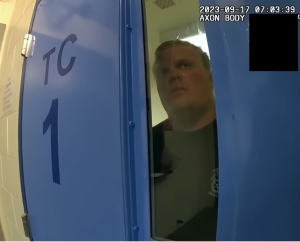
Jason Killilnger in Jail Cell – Youtube screenshot
Responding Officer Jager commented to the casino security, “If the software’s saying it, then it’s legit.” When he called in to police records, he asked the records person if he saw a resemblance between the two photos. The man replied, “Yeah, a little bit.” Officer Jager didn’t believe Killinger was who he said he was because the casino’s software is “pretty cool.” His supervisor suggested that he would need to place Killinger under arrest and identify him via a fingerprint check. Neither one thought of checking other forms of ID. Killinger also had in his possession a debit card with his name. In his vehicle, there were vehicle registration paperwork, an insurance card, a medical card, a union card, other casino player’s cards, and a pay stub all identifying him. M.E. weighed 50 pounds less than Jason. The two men had different colored eyes. Killinger’s license also had special CDL endorsements which M.E.’s did not. Killinger asked if the signatures on the licenses were the same, and the officer responded that no, they were different names. No effort to compare the writing style was made.
Once he was positively identified as Jason Killinger, unfortunately, the prosecution continued. Jason had to hire an attorney and make a court appearance. The case ended up being dismissed without prejudice, which allows prosecutors to re-charge him within a year, as the city prosecutor was unwilling to completely let the matter go.
Lessons from the Trenches
As a software developer myself, humans deferring to technology bothers me. I understand the limits of technology. The parks system I work with uses cameras to verify the license plates of customers. The system improves the convenience of customers and staff alike in not having to obtain a physical window sticker. You can pay online and rely on the system to read your license plate to verify your pass. The system also can identify people who do not have a pass and can be reminded by mail to pay afterward. Repeat offenders will be met with additional fees, and in the most extreme situations, referred to court.

Image by DC Studio on Freepik
However, the entire staff is well aware of the limitations of the license plate recognition software. Depending on conditions, obstructions, plate styles, etc., the plate may not be captured accurately or completely. There are many safeguards we put in place to try to keep the bad data manageable. For example, we set the threshold for plate accuracy to 90% or better, which discards the majority of scans, but it is still worthwhile to follow up with the remaining ones. Even then, it is understood that the software will have misidentified a percentage of people. When the violation notices go out, a team of staff members are enlisted to field calls from people who wish to contest the fee. Bless their hearts, this team of people deal professionally with some irate folks, even those who have never visited our parks. They work diligently to resolve these complaints and make sure the people will not receive another false identification. A human being can easily spot where the software has gone wrong by reviewing the actual vehicle photo. And a human being with even a little “horse sense” can resolve the issue with tact when someone has been misidentified. Law officials who put too much confidence in the software may be lazy or dazzled by the “super cool” technology. They forget that computer wizardry can go frustratingly wrong at times. One maxim of the IT field is “To err is human, but to really mess things up takes a computer.”
Listen to this blog post as an audio file below.