
The Brain Death Fallacy

By: Michaeljon Murphy
Director of Communications
Constitution Party of Wisconsin
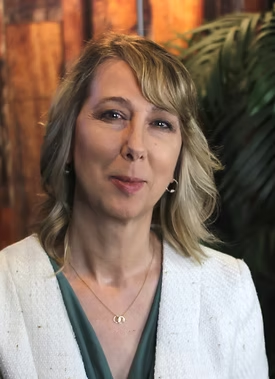
At our 2025 State Convention, held on November 8, one of our speakers was Dr. Heidi Klessig. Dr. Klessig is a board-certified anesthesiologist who retired in 2007 to care for her husband who had been diagnosed with a brain stem tumor. She also homeschooled her two children through high school. She now uses her experience in the medical field and further in-depth study into the ethics of organ donation as an author and speaker. Her topic at the CPoW convention was “The Dangers of Organ Donation.”
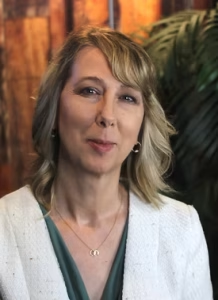
Dr. Heidi Klessig
The presentation was an enlightening and at times jarring deep dive into the history of organ donation. When she was first asked to prepare a “brain-dead” patient for transplant surgery, she assumed that she would not have to administer the standard consciousness blocker, since the donor was already dead. The supervising surgeon appeared surprised at her naïveté, and coyly cautioned her to include the drug “just in case.” This began her odyssey of asking questions.
She found that organ procurement has greatly influenced the redefinition of death. She included a quote from a Mayo Clinic neurocritical care specialist who said,
…the diagnosis of brain death is driven by whether there is a transplantation programme or whether there are transplantation surgeons. I do not think brain death examination now, in practice, would have much, if any meaning if it were not for the sake of transplantation.
Dr. Felco F. Wijdicks, MD, PHD, 2006
The Changing Definition of Death
The definition of death has changed significantly a number of times in the past 60 years, apparently being shaped by the need for organ donation.
1968 was the year of the first adult heart transplant. That year, a group of 13 from Harvard Medical School introduced a new criterion for death – “irreversible coma.” They based this on utilitarian arguments, not on any new tests or studies. Comatose people could be declared “dead,” which would avoid the dead donor rule, which stated that people must neither be alive when the organs are removed nor killed in the process of organ removal.
In 1981, medical and legal groups developed and promoted the UDDA (Uniform Determination of Death Act), which gave guidelines for the determination of death. Death could be declared in 2 ways:
An individual who has sustained either
- An irreversible cessation of circulatory and respiratory functions, or
- Irreversible cessation of all functions of the entire brain, including the brain stem, is dead. A determination of death must be made in accordance with accepted medical standards.
This model state law has been adopted in some form by all states today.
Later documented cases of people that lived, some long after a diagnosis of brain death caused a further change in the criteria.
In 2008, the President’s Council on Bioethics: Controversies in the Determination of Death coined a new term, “Total brain failure.” The meaning of this term is that an organism is no longer alive when it ceases to perform the “fundamental vital work of a living organism – the work of self-preservation, achieved through the organism’s need-driven commerce with the surrounding world.”
This centered around the factors of breathing and consciousness and, in essence, changed the definition from biological to philosophical. People qualifying under this term may show EEG activity and/or have a functioning hypothalamus.
In 2023, further brain death testing guidelines were developed which focused on unresponsiveness and response to stimuli. It is a subjective, bedside diagnosis.
A True Definition of Death

Morgue P.J.L Laurens, CC BY-SA 3.0, via Wikimedia Commons
The traditional definition of death based on when someone’s heart stops beating is also subject to abuse. True death is cardiac death beyond all hope of resuscitation. Just because there is a DNR order does not mean the patient is dead when his/her heart stops beating. There is the possibility of resuscitation. In fact, as part of the transplantation process, the heart may be restarted to improve its condition prior to the transfer. The arteries going to the brain will be clamped off before restarting the heart, ensuring the donor remains “brain-dead” even after the restoration of circulation.
Dr. Klessig called for more education to help people make better end-of-life decisions. She warns against the unethical practices and definitions that enable organ procurement. Her website offers much more detail on this and other topics. There is even a section with information about how to remove yourself from the organ donation list. The site has links to social media, books, and videos. Please take advantage of her resources.
Listen to this blog post as an audio file below.