
We Must Fight Threats to Our American Republic
 By Andrew Zuelke
Chairman, Constitution Party of Wisconsin
There is a great deal of confusion over an issue the Founding Fathers resolved back in the 18th Century: are we a republic or a democracy?
How many leftists in America have said, “Donald Trump is a threat to our democracy”? But Republicans are guilty of this too.
On December 4, 2024, WBAY reporter Jason Zimmerman wrote about Assemblyman David Steffen (R) of Howard reintroducing a proposal banning judge shopping in Wisconsin. Steffen, speaking against judge shopping, said, “I don’t think that’s good for democracy.”
The Existential Threat to Democracy
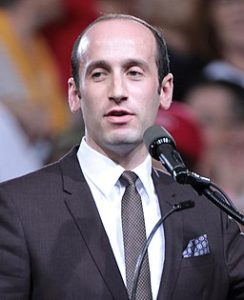
Stephen Miller
Gage Skidmore, CC BY-SA 3.0 , via Wikimedia Commons
On February 21, 2025, White House Deputy Chief of Staff Stephen Miller said this in a press briefing. “The threat to democracy, the existential threat to democracy, is the unelected bureaucracy of lifetime tenure civil servants who believe they answer to no one, who believe they can do whatever they want without consequence, who believe they can set their own agenda no matter what Americans vote for.
I agree the bureaucrats need to be reined in and accountable to “We the People.” Miller added, “What President Trump is doing is he is removing federal bureaucrats who are defying democracy by failing to implement his lawful orders which are the will of the whole American people.”
Article 4: Section 4 of the US Constitution could not be clearer: The United States shall guarantee to every State in this Union a Republican Form of Government.
The Founding Fathers were hardly foolish men; they learned well the lessons of history regarding different forms of government. When drafting the Constitution, they were not confused, writing in the Constitution the word “Republican” instead of “Democratic.” The Founders knew the differences between the two. At the Constitutional Convention in Philadelphia they discerned, correctly, that a republic would serve the new nation best. No, it is modern-day leaders who are confused about a republic and a democracy… or are they blurring the distinctions between the two intentionally for their benefit?
Mob Rule
How would politicians and activists benefit from doing that? In a nutshell, democracy is mob rule (simple majority vote) and a republic is rule of law (individual citizens have inalienable rights from birth). Under a republic, to amend the Constitution, there is an amendment process; no one can just vote away whole parts of the Constitution by a 50 plus 1 vote. If power-grabbing leftists in America can successfully convince school children that America is a democracy, they will grow up believing that a simple majority vote decides everything, including what rights you and I have, what we are allowed and not allowed to say (hate speech, so-called disinformation, and silence dissenting voices online and elsewhere), whether we are allowed self-defense (gun bans, red flag laws), whether ownership/use of certain property should be allowed or land usage should be restricted by the government to fight threats to the environment (wetlands laws, endangered species acts) for the “common good.” Then, once these generations reach adulthood and move into positions of authority, they will ignorantly act on this taught falsehood that America is a democracy and rule accordingly.

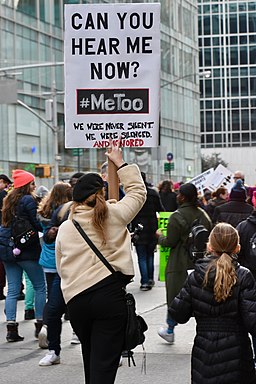
The Me-Too Movement Alec Perkins from Hoboken, USA, CC BY 2.0, via Wikimedia Commons
Democracy Causing Problems
Democracy is already causing major problems. Besides the demonizing of accused citizens in the court of public opinion, we had the “Me-Too Movement” and “Believe All Women” in cases of rape. We have people acting as though it is somehow wrong to expect the accuser (the assaulted woman) to have to prove in a court of law that she was assaulted by the accused, which somehow the burden of proving innocence should be on the accused, that due process unfairly favors the accused and we as a nation must “balance the scales” in favor of the victims again. The more serious the crime one is accused of, the more they need their inalienable rights like innocent until proven guilty and due process. Someone who is accused of murder will face more serious penalties than someone accused of shoplifting or embezzlement.
We have asset forfeiture laws which violate a citizen’s 4th and 5th Amendment rights to property and due process (their day in court). These laws allow local authorities to seize a citizen’s property if said authorities believe said property (money in a person’s car, for example) was gained through illegal activity, no proof required by the sheriff or deputy. Guess what? These laws which violate Constitutional rights were democratically approved by a “majority vote” of Congress. There are examples of Supreme Court majority denying citizens their property through misuse of eminent domain for private – not public – use like the case of Kelo v. City of New London in 2005. https://.legaldictionary.net/kelo-v-city-new-london
If you want to say there are similarities between a republic and a democracy, you will get no argument from Constitutionalists. Both elect candidates by a majority vote and have legislatures pass laws by a majority vote, but under a republic, certain things cannot be altered or voted away by a majority, like inalienable rights. Apples and oranges have similarities too (both are high in vitamin C, grow on trees, have peels and seeds), but as I have written about before, they do not taste the same and that one difference is huge.
A Little, Minor Thing?
You might be thinking, “Andrew, we have so many problems to tackle in our nation, and you want to talk about this little, minor thing about the form of government we have?”
The form of government we have is a big deal. If any leftist was accused of a capital crime, would he/she be satisfied with just seven of the twelve jurors deciding they were guilty? Under a republic, a unanimous verdict is required because of the consequences of a possible guilty verdict: the loss of one’s liberty and curtailing of his/her rights for a set period of prison time and in states where there is the death penalty for certain crimes, the possible loss of a convicted citizen’s life.
But let us assume that calling the United States of America a democracy is no big deal. If that is true, then it should be a simple matter for Americans to settle so we can quickly move on to the bigger issues. We just need to come to a consensus on three undeniable truths. 1) the written Constitution itself says republican, not democratic and 2) there are differences between the two; they are NOT the same, and 3) our elected officials take an oath to uphold and defend the Constitution, and the word republican is in there, democracy or democratic are not.
Listen to this blog post as an audio file below.